Why Temp Mail Has Become One of the Most Searched Privacy Tools Online
Not long ago, if you asked the average internet user to name an online privacy tool, they would say VPN. Maybe a password manager if they were paying attention. Temp mail would not have come up. It was not part of the mainstream conversation around digital privacy and most people had simply never heard of it.
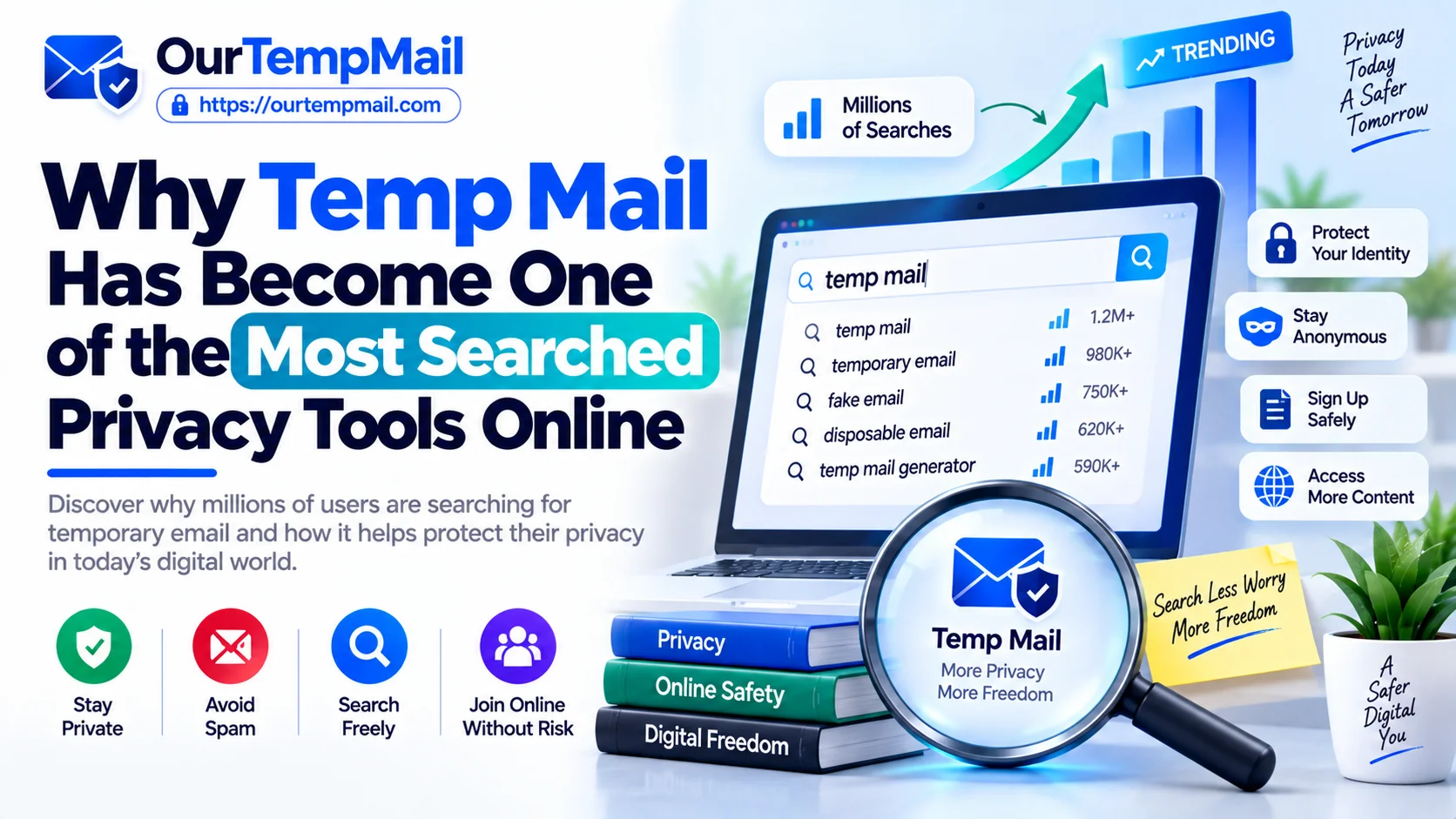
That has changed. Search data from 2026 tells a different story. Terms like temp mail, disposable email, and fake email generator are being searched at volumes that put them firmly alongside more established privacy tools. In some markets, searches for temporary email services outpace searches for VPNs in certain demographic groups. The tool has gone mainstream faster than most people in the privacy space expected.
Understanding why this happened is not just an interesting data point. It reveals something meaningful about how everyday internet users think about privacy today, what they are actually worried about, and what kind of solutions they are looking for. This guide covers all of it.
Privacy Tools Used to Feel Technical
For most of the internet's history, privacy tools were associated with technical users. VPNs were for people who understood network routing. Encrypted email was for journalists and activists. Password managers were for security professionals. The average person either did not know these tools existed or assumed they were too complicated to be worth learning.
This created a large gap between the people who understood privacy risks and had the tools to manage them, and the much larger group of everyday users who were just trying to get things done online without necessarily thinking about what happened to their data in the process.
What changed is that privacy problems became personal and visible in ways they had not been before. It was no longer abstract. It was your inbox full of spam from a platform you visited once. It was a promotional email from a company you had never heard of with your name in the subject line. It was a security notification from a service telling you your data may have been exposed in a breach.
When privacy problems become visible and personal, people search for solutions. And when the solution is as simple and accessible as a temp mail service, it spreads quickly.
The Inbox Problem Is Universal
Every internet user, regardless of their technical knowledge or privacy awareness, has experienced inbox overload at some point. The volume of unwanted email that accumulates from years of online sign-ups is something that touches almost everyone who has had the same email address for more than a few years.
This universality is a big part of why temporary email search volumes have grown so broadly across different demographics and geographies. You do not need to understand data privacy legislation or tracking technology to understand that your inbox is full of things you do not want and that somehow your email address keeps ending up with companies you do not remember giving it to.
The search behavior reflects this. People are not searching for temp mail because they read a privacy blog or attended a security conference. They are searching for it because they are frustrated with their inbox and they found out through a friend, a forum post, or a social media comment that a disposable email address could have prevented the problem. The tool spreads through word of mouth and shared frustration more than through formal privacy education.
It Solves a Problem Without Asking Much in Return
One of the most important reasons temp mail has become so widely searched is that it is genuinely easy to use. This separates it from most privacy tools, which carry some kind of learning curve, setup requirement, or ongoing management cost.
A VPN requires installation, configuration, and a monthly subscription. An encrypted email service requires the recipient to also use compatible software. A password manager requires time to set up and a behavioral change around how you log into things. These are all worthwhile investments for the right user but they represent a meaningful commitment that many people put off or never get around to.
A disposable email address from a service like Our Temp Mail requires nothing. You open the website, the address is there, you copy it, and you use it. The entire interaction takes less than thirty seconds and changes nothing about how you use the internet except what email address you enter into sign-up forms. This minimal friction is a major reason why people who discover it tend to keep using it and why they recommend it to others.
Spam Has Become a Mainstream Grievance
Spam email has always existed but the nature of it has changed in ways that have pushed more people to actively look for solutions. The old-fashioned spam of a previous era, obvious scams and irrelevant bulk messages, was easy to recognize and ignore. The spam that fills inboxes today is harder to dismiss.
It comes from brands people have actually interacted with. It uses their name. It references purchases they made or platforms they visited. It arrives from services they technically agreed to hear from when they clicked through a sign-up form without reading the fine print. It is more sophisticated, more targeted, and in many cases more difficult to stop once it has started.
This evolution in spam has driven a corresponding evolution in how people think about protecting their inbox. A burner email for free trials and one-time registrations is no longer seen as an extreme privacy measure. It is increasingly seen as a reasonable response to a problem that has become genuinely difficult to manage any other way.
Generate a Free Temporary Email Instantly on ourtempmail.com
Social Media and Data Scandals Accelerated Awareness
A series of high-profile stories about how technology companies handle user data have had a lasting effect on how ordinary people think about sharing personal information online. These stories reached audiences far beyond the tech press. They were covered in mainstream media, discussed on social platforms, and shared widely enough to shift public attitudes in a meaningful way.
The specific details of what companies do with email addresses, how they are used for advertising targeting, how they end up in the hands of third parties, and what happens when databases containing them are breached became part of a broader public conversation that had not happened before at the same scale.
This awareness did not make everyone a privacy expert but it did make a lot of people more cautious about what contact information they share and more motivated to look for alternatives when they can. Searching for a fake email generator or a disposable email service is a direct response to this heightened awareness, and the search volumes reflect how widely that response has spread.
The Free Trial Economy Created a Specific Use Case
The growth of subscription software, streaming services, and digital products offered on a free trial basis has created a specific and widely shared frustration. You try a product, decide it is not for you, and then spend weeks receiving emails designed to convert you into a paying customer. Unsubscribing helps sometimes but does not always stop the contact entirely.
The search phrase burner email for free trials is one of the faster-growing variations of temp mail search terms because it reflects a specific pain point that a large number of people have experienced directly. The demand here is not abstract. It is people who have been through the free trial cycle enough times to actively look for a way to access trials without the follow-up sequence that comes with them.
Our Temp Mail handles this use case cleanly. The trial account is created, the product is evaluated properly, and when the trial ends there is no working email address for the follow-up campaign to reach. The free trial was genuinely free in every sense of the word.
Younger Users Are Driving Search Growth
A notable pattern in the growth of temp mail searches is that younger internet users are disproportionately represented. This makes sense for a few reasons. Younger users tend to sign up for more platforms, try more new apps, and engage with more online communities than older demographic groups. They also tend to be more privacy-aware, having grown up in an environment where data collection practices were already a subject of public conversation.
Younger users are also more likely to share tools and tips through social media, group chats, and online communities. When one person in a friend group discovers that a disposable email solves the inbox spam problem, they share it and the knowledge spreads laterally in a way that older information-sharing patterns did not support as effectively.
This creates a self-reinforcing cycle. More young users discover temp mail, share it with their networks, those networks search for it, and the overall search volume grows. The trend is building on itself in a way that suggests continued growth rather than a peak followed by decline.
Global Search Growth Reflects Global Adoption
The growth in temp mail searches is not concentrated in any single region or language. Search data shows growth across markets in South and Southeast Asia, Sub-Saharan Africa, Latin America, and Eastern Europe alongside continued growth in more established markets in Western Europe and North America.
This global spread reflects the universal nature of the problem that disposable email solves. Spam does not respect borders. The email-for-access model is used by platforms serving users in every country. The frustration that drives people to search for a solution is the same regardless of where they are, even if the specific platforms and services involved differ by region.
Our Temp Mail is built to serve this global user base. The service works on any browser and any device, requires no language-specific setup, and functions identically whether you are in Lagos, London, Jakarta, or New York. This accessibility is part of why the platform sees users from across the world every day. For anyone looking at the full range of options available, our guide on the best temp mail services for 2026 and 2027 is a useful reference point.
What Makes Temp Mail Different From Other Privacy Tools in Search Behavior
Most privacy tools are discovered through deliberate research. Someone decides they want more privacy, researches their options, reads comparison articles, and eventually chooses a tool. The decision is considered and the path to adoption is relatively long.
Temp mail is often discovered differently. Someone has a specific, immediate problem. Their inbox is full. They are trying a free trial and want to avoid the follow-up. They need to register on a site but do not want to give their real email. They search for a solution to that specific problem, find temp mail, and start using it within minutes. The path from problem to adoption can be measured in minutes rather than days.
This immediacy is reflected in the search intent behind temp mail queries. They tend to be highly action-oriented. People searching for disposable email are usually ready to use one right now, not researching for a future decision. This is why platforms like Our Temp Mail that deliver on the promise instantly, without any friction, are seeing the strongest growth. The tool has to work immediately or the user moves on.
Final Thoughts
Temp mail has become one of the most searched privacy tools online because it solves a real, widely shared problem in the simplest possible way. It does not require technical knowledge, a subscription, or a behavioral change beyond one small decision at the point of signing up for something online. That combination of genuine usefulness and minimal effort is rare, and it is why the tool has spread so far so quickly.
The search growth is not a trend that is going to reverse. The conditions driving it, the volume of online sign-ups, the sophistication of email marketing, the increasing awareness of data privacy, and the growing global internet user base, are all continuing in the same direction. More people will discover temp mail next year than discovered it this year.
If you are reading this and have not yet made a disposable email address part of your regular online routine, the good news is that starting could not be simpler. Visit ourtempmail.com and your free temp mail address is ready before you have done anything at all.
Generate a Free Temporary Email Instantly on ourtempmail.com