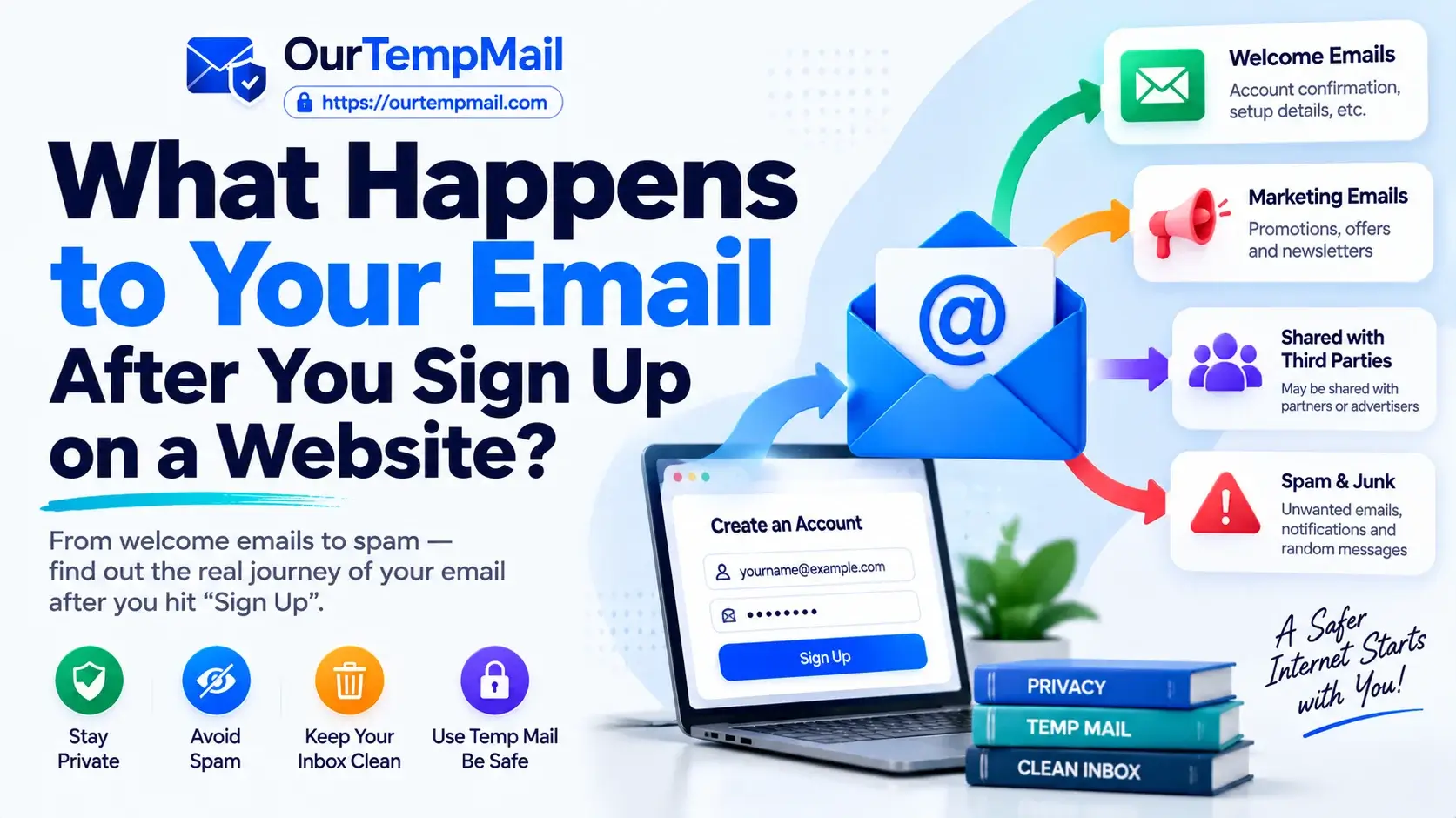
What Happens to Your Email After You Sign Up on a Website?
You find a website you like. There is a free resource, a discount code, an app you want to try, or an article behind a registration wall. You fill in the form, enter your email address, and click the button. A confirmation arrives, you get what you came for, and you move on.
But your email address does not move on. From the moment you hit submit, it starts a journey you probably never thought about and almost certainly never agreed to in any meaningful way. Understanding what actually happens next is one of the most useful things you can do for your inbox and your online privacy.
This guide walks through exactly what websites do with your email address after you sign up, why your inbox fills up with things you never asked for, and what the smarter alternative looks like.
Step One: You Land on Their Mailing List
The first thing that happens is simple. Your email address gets added to a list. Every website that collects emails maintains some version of a subscriber or contact database, and from the moment you register your address sits in that database alongside everyone else who has ever signed up.
For some websites this is genuinely just about sending you the account confirmation and the occasional product update. But for many platforms, especially those offering something free in exchange for your email, the list itself is the point. They are building an audience they can market to repeatedly, and you just joined it.
The first email after sign-up is almost always innocent. A welcome message, a confirmation link, maybe a quick introduction to what they offer. What comes after that depends entirely on the platform and how aggressively they use their list.
Step Two: The Marketing Emails Begin
Once you are on the list, the emails start. The pace varies. Some platforms send one newsletter a week and keep it reasonable. Others send daily promotional emails, flash sale alerts, re-engagement campaigns, referral requests, and product announcements that have nothing to do with why you signed up in the first place.
This happens because email marketing is one of the most cost-effective channels available to businesses. Sending an email to ten thousand subscribers costs almost nothing compared to paid advertising, and even a small conversion rate makes it worthwhile for them. The fact that most of those ten thousand people did not really want to receive daily emails is not the platform's primary concern.
The volume can become overwhelming quickly, especially if you have signed up for multiple websites over a period of months or years. What starts as a few extra emails turns into an inbox that requires daily management just to stay usable.
Step Three: Your Email Gets Shared or Sold
This is the part most people do not think about when they hand over their email address. A significant number of websites and platforms sell or share their subscriber lists with third parties. This can happen in a few different ways.
Some platforms have explicit data sharing agreements with advertising partners. Your email address and the associated behavioral data get passed to these partners so they can target you with ads and campaigns. The privacy policy you agreed to without reading when you signed up almost certainly mentioned this somewhere, buried in legal language most people never look at.
Others sell their lists outright when they wind down a service, get acquired by another company, or simply decide the data is worth monetizing. Your email address, which you gave to one platform for one specific purpose, ends up in the hands of companies you have never heard of and never interacted with.
This is how you start receiving emails from brands that have no obvious connection to anything you remember signing up for. Your address traveled from the original platform to somewhere else entirely, and from there it may travel again.
Step Four: Data Breaches Expose What Was Supposed to Stay Private
Even platforms with good intentions can have bad outcomes. Data breaches are one of the most common ways personal information including email addresses ends up somewhere it should never be.
When a platform's database is compromised, every email address stored in it gets exposed. Depending on what else was in the database, this can mean your address ends up on lists used for phishing campaigns, credential stuffing attacks, or targeted scams. You may never know the breach happened until you start receiving suspicious emails that reference your name or account details.
The more websites you give your real email address to, the more databases it ends up in. The more databases it sits in, the higher the chance that at least one of them eventually gets breached. This is a numbers problem as much as anything else, and the numbers get worse every year you spend freely handing out your real address.
Step Five: Unsubscribing Does Not Always Work
Most marketing emails include an unsubscribe link at the bottom, and in theory clicking it should stop the emails. In practice it is more complicated than that.
Legitimate platforms honor unsubscribe requests promptly. But some do not. Re-adding unsubscribed addresses to lists, splitting mailing lists across multiple systems so that unsubscribing from one does not affect another, and simply ignoring unsubscribe requests are all practices that happen more often than they should.
There is also the issue of what unsubscribing actually confirms. On some platforms, clicking the unsubscribe link tells the sender that your email address is active and being monitored, which can make it more valuable rather than less. Some less reputable email operators use this as a signal to sell the address at a higher price.
Even when unsubscribing works perfectly, it does not remove your address from the database or undo any sharing that has already happened. Your email is still out there. It is just on a slightly shorter list of who gets to contact you directly.
Generate a Free Temporary Email Instantly on ourtempmail.com
What the Pattern Looks Like Over Time
Most people who have had the same email address for more than a few years have experienced this pattern in their inbox without fully connecting the dots. The promotional emails from a software tool they tried once. The newsletter from a blog they visited to read one article. The discount alerts from a retailer they bought from once three years ago. The suspicious emails from senders they have no memory of.
Each of these is the result of one sign-up. One moment where an email address was entered into a form and added to a list. Multiply that by every registration, every free trial, every download, and every account created over the years, and the picture becomes clear. An inbox that started as a useful communication tool has slowly been colonized by the cumulative result of every time a real email address was shared without much thought.
The frustrating part is that most of it was avoidable. Not because you should have read every privacy policy or refused to sign up for things online, but because there is a straightforward alternative that most people simply do not know about or have not made into a habit yet.
The Smarter Alternative: Use a Disposable Email Address
A disposable email address does exactly what it sounds like. You get a real, working email address that receives messages, delivers verification links, and handles OTP codes just like any regular inbox. The difference is that it is not connected to your identity, it does not sit in anyone's database permanently, and when you are done with it the address disappears completely.
When you use a fake email generator or temp mail service for a sign-up, the confirmation email arrives in your temporary inbox. You click the link, access what you came for, and move on. The platform adds your address to their list, sends their marketing emails, and shares it with whoever they share it with. But none of that reaches you because the address is already gone. The entire chain that normally starts with a sign-up breaks at step one.
If you want to understand exactly how temp mail works and why it is so effective for this, our guide on what is temp mail and how does it work covers everything in detail. The short version is that it gives you all the access you need from any registration without any of the consequences that usually follow.
When to Use a Disposable Email and When to Use Your Real One
A disposable email is the right choice whenever the relationship with a website is genuinely one-time or short-term. Free trials you are not sure about, downloads you need once, forums you want to browse without committing to a newsletter, and any platform you have never used before and may never use again. These are exactly the situations where handing over your real email address creates long-term costs for zero long-term benefit.
Your real email address belongs with the platforms and services that genuinely matter. Banking, healthcare, work communication, government services, and any account where you need reliable long-term access and where a password reset might one day be essential. These are situations where a burner email for free trials would actually cause problems, because the inbox disappears and you lose access.
The distinction is simpler than it sounds. If you are planning to come back, use your real email. If you are not sure or you know you will not, use a temp mail address and protect your inbox from everything that would otherwise follow.
Final Thoughts
Your email address is more valuable than most people realize when they hand it over to a website. It connects to your identity, your accounts, and your long-term online presence. Every time it goes into a database it takes on a life of its own, moving through marketing systems, data agreements, and potentially breach events that you have no control over and may never know about.
The good news is that protecting yourself from this is genuinely straightforward. Using a disposable email for sign-ups that do not need your real address is one of the simplest habits you can build online, and the difference it makes to your inbox and your privacy compounds over time.
Our Temp Mail gives you a free, instant, anonymous email address whenever you need one. No account, no cost, and no trace left behind. The next time a website asks for your email and you are not sure what they are going to do with it, now you know the answer. And now you know what to give them instead.
Generate a Free Temporary Email Instantly on ourtempmail.com
Tags:
#what happens to your email after sign up