Temp Mail vs Email Alias: Which One Actually Protects Your Privacy?
Most people discover they need some kind of email privacy solution after something goes wrong. Their inbox fills up with spam from a website they visited once. They start receiving calls from companies they never contacted. A platform they signed up to years ago suddenly starts sending daily emails and the unsubscribe button does not seem to work.
At that point, the question becomes what to actually do about it. Two options come up regularly. Temp mail and email aliases. Both are designed to protect your real email address but they work in completely different ways, serve different purposes, and suit different types of people.
This guide breaks down exactly how each one works, what the real differences are between them, where each one falls short, and how to figure out which one makes more sense for your situation.
What Is Temp Mail?
A temp mail service gives you a disposable email address that exists for a short period of time. You visit ourtempmail.com and a working inbox is generated for you instantly with no sign-up, no account, and no personal information required. You use the address wherever you need it, receive whatever emails are sent to it, and when the session ends the inbox disappears completely.
There is no connection between the temporary address and your real identity. The service does not know who you are, does not store your messages after deletion, and does not require you to create any kind of profile. It is a completely anonymous, one-time inbox that does its job and then ceases to exist.
If you want to understand how temp mail works at a deeper level before reading this comparison, our guide on what is temp mail and how does it work covers everything from the basics to real-world use cases. Temp mail is also commonly called a throwaway email, burner email, or fake email generator. The names are different but the concept is the same.
What Is an Email Alias?
An email alias is a different kind of privacy tool. Instead of giving you a completely separate inbox, it gives you an alternate email address that forwards incoming messages to your real inbox. You create an alias through a service or directly through your email provider, use it on websites, and any emails sent to that alias land in your actual inbox rather than a separate one.
The key difference is that an alias is permanent and tied to a real email account. It is not anonymous in the same way that temp mail is. The alias service or email provider knows who you are and what your real address is. From the outside the alias looks like a separate address but behind the scenes it points back to you.
Email aliases are available through some email providers natively and through dedicated services that specialize in email forwarding and privacy. Some are free with limitations, others require a paid subscription for full functionality.
How They Compare: The Key Differences
Anonymity
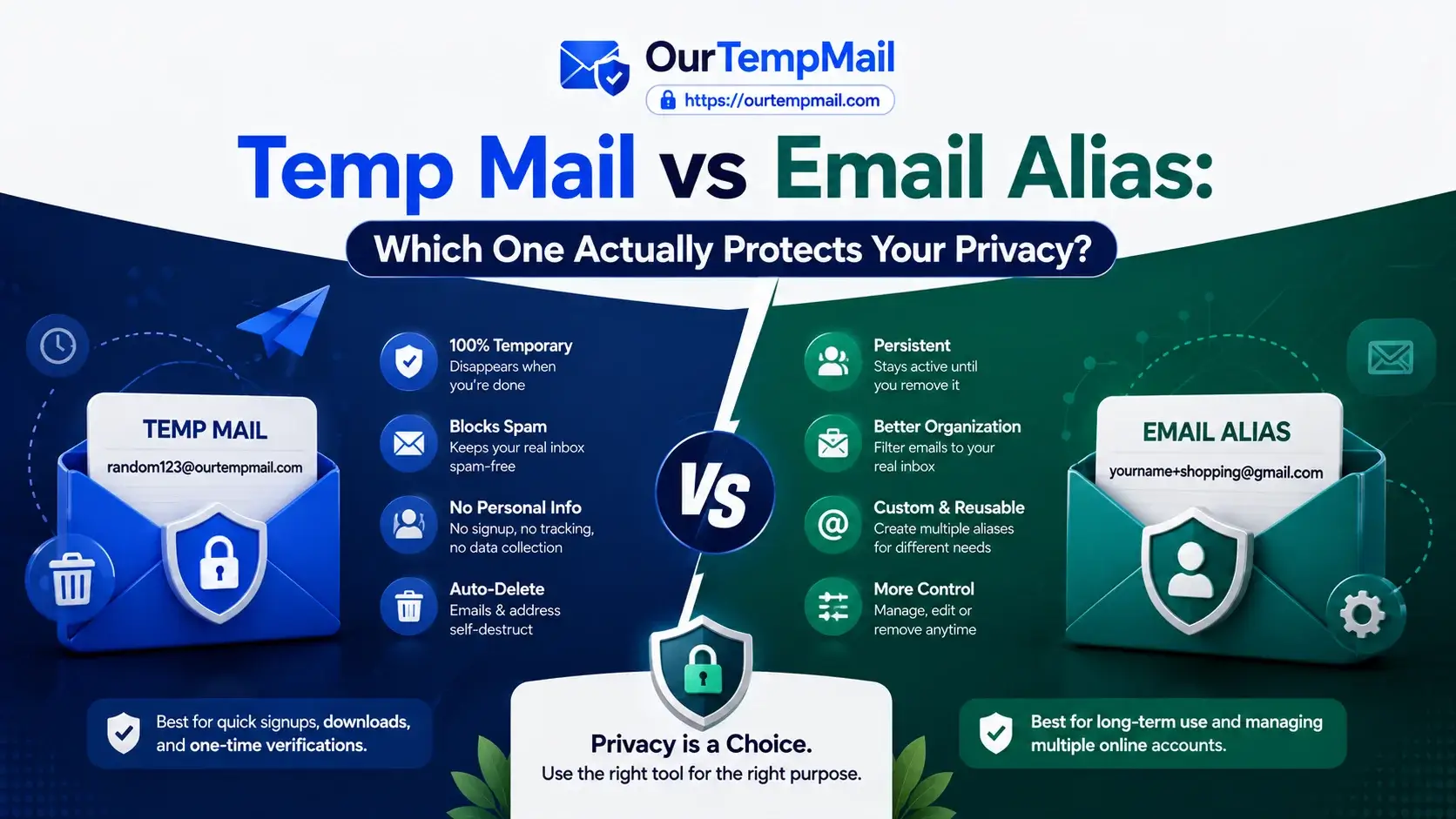
This is where temp mail has a clear advantage. A disposable email address from a service like Our Temp Mail has zero connection to your identity. No account, no name, no real email in the background. The address exists in isolation and disappears when you are done.
An email alias is different. It requires a real email account to forward messages to. The alias service itself knows who you are, even if the website receiving the alias does not. If the alias service is ever breached or compelled to share data, your real identity and email address could be exposed.
How Long the Address Lasts
A temp mail address is short-lived by design. It exists for the duration of your session and then it is gone. This is ideal for one-time use but not suitable for situations where you need ongoing access to an account.
An email alias is permanent for as long as you keep it active. You can use it across multiple platforms over months or years and it keeps working. You can also disable specific aliases if a particular website starts sending too much, which gives you a level of control that a temporary address cannot offer.
Inbox Management
With a burner email for free trials or any other short-term use, the temp mail inbox is separate from everything else. Nothing lands in your real inbox from that session. It is completely isolated.
With an alias, everything still arrives in your real inbox. The alias filters where messages come from but they all end up in the same place. For some people that is fine. For others it defeats part of the purpose because the inbox still fills up, just from alias addresses rather than direct ones.
Setup and Effort
Using temp mail requires no setup at all. Visit the website, copy the address, use it. There is nothing to configure, no account to manage, and no settings to adjust. It is the fastest privacy tool available.
Setting up an email alias takes more effort. You need to sign up for a service, configure the forwarding rules, and manage which aliases are active. It is not complicated but it is a step beyond what temp mail requires.
Cost
Our Temp Mail and most disposable email services are completely free. There is no subscription, no paid tier required for basic use, and no limit on how many temporary addresses you can generate.
Email alias services vary. Some offer a free tier with restrictions on the number of aliases or forwarding volume. Full functionality often requires a monthly or annual payment. For heavy users this may be worth it but for casual privacy needs it adds a cost that temp mail simply does not have.
Generate a Free Temporary Email Instantly on ourtempmail.com
Where Temp Mail Works Best
One-Time Sign-Ups and Registrations
When you need to register on a website once to access something and have no intention of returning, a temp mail address is the perfect solution. You get through the registration, take what you came for, and the address disappears. The website has no way to reach you afterward.
Free Trials and Gated Content
Using a burner email for free trials is one of the most practical applications of temp mail. Access the trial, evaluate the product, and move on without your real inbox receiving follow-up sales emails for months afterward.
Developer and App Testing
Developers who need to create multiple test accounts, verify sign-up flows, or check email delivery can use a fake email generator to spin up as many addresses as they need without creating real accounts or mixing test data with live user information.
Protecting Your Identity on Unfamiliar Sites
If you are visiting a website for the first time and are not sure about its data practices, a disposable email address protects you from whatever they might do with your contact information. You get what you need without leaving any real trace behind.
Where Email Aliases Work Best
Ongoing Accounts You Need to Keep
If you need to maintain access to an account over a long period, an email alias makes more sense than temp mail. The alias stays active, messages keep arriving, and you retain the ability to log back in whenever you need to.
Organizing Emails From Different Sources
Some people create different aliases for different categories of sign-ups. One for shopping, one for newsletters, one for professional services. When a specific alias starts receiving too much junk, they disable it. This kind of organization is simply not possible with a disposable email address.
Keeping Your Real Address Hidden Long Term
If you want to use a consistent address across multiple platforms without ever exposing your actual email, an alias lets you do that. The alias looks permanent and reliable to anyone who receives it but your real address stays hidden behind the scenes.
The Honest Verdict: Which One Should You Use?
The answer depends entirely on what you are trying to do.
If you need something quick, anonymous, and completely free for a one-time situation, temp mail is the right choice. Visit ourtempmail.com, grab a disposable email address, use it, and move on. There is nothing to set up, nothing to pay, and no trace left behind when you are done.
If you need an address that lasts, that you can receive ongoing messages through, and that gives you control over which sources can reach you over time, an email alias is worth exploring. It requires more effort and often a subscription but it suits long-term situations that temp mail is not designed for.
For most everyday situations, combining both tools is actually the most practical approach. Use temp mail for anything one-time, unfamiliar, or temporary. Use an alias for platforms you plan to stick with but do not want to give your real address to. If you want to explore your options further, our guide on the best temp mail services for 2026 and 2027 is a good next step.
Final Thoughts
Email privacy is not a single tool problem. Different situations call for different solutions and understanding the difference between temp mail and email aliases puts you in a much better position to make the right call every time.
What is clear is that doing nothing and handing your real email address to every website that asks is the option with the highest long-term cost. Both temp mail and email aliases are better than that, and both have a place in a sensible approach to managing your online privacy.
If you want to start somewhere simple and free, Our Temp Mail is ready for you right now. No sign-up, no setup, no commitment. Just a working disposable email address whenever you need one.
Generate a Free Temporary Email Instantly on ourtempmail.com
Tags:
#temp mail vs email alias
#email alias
#email privacy tools
#disposable email
#temp mail