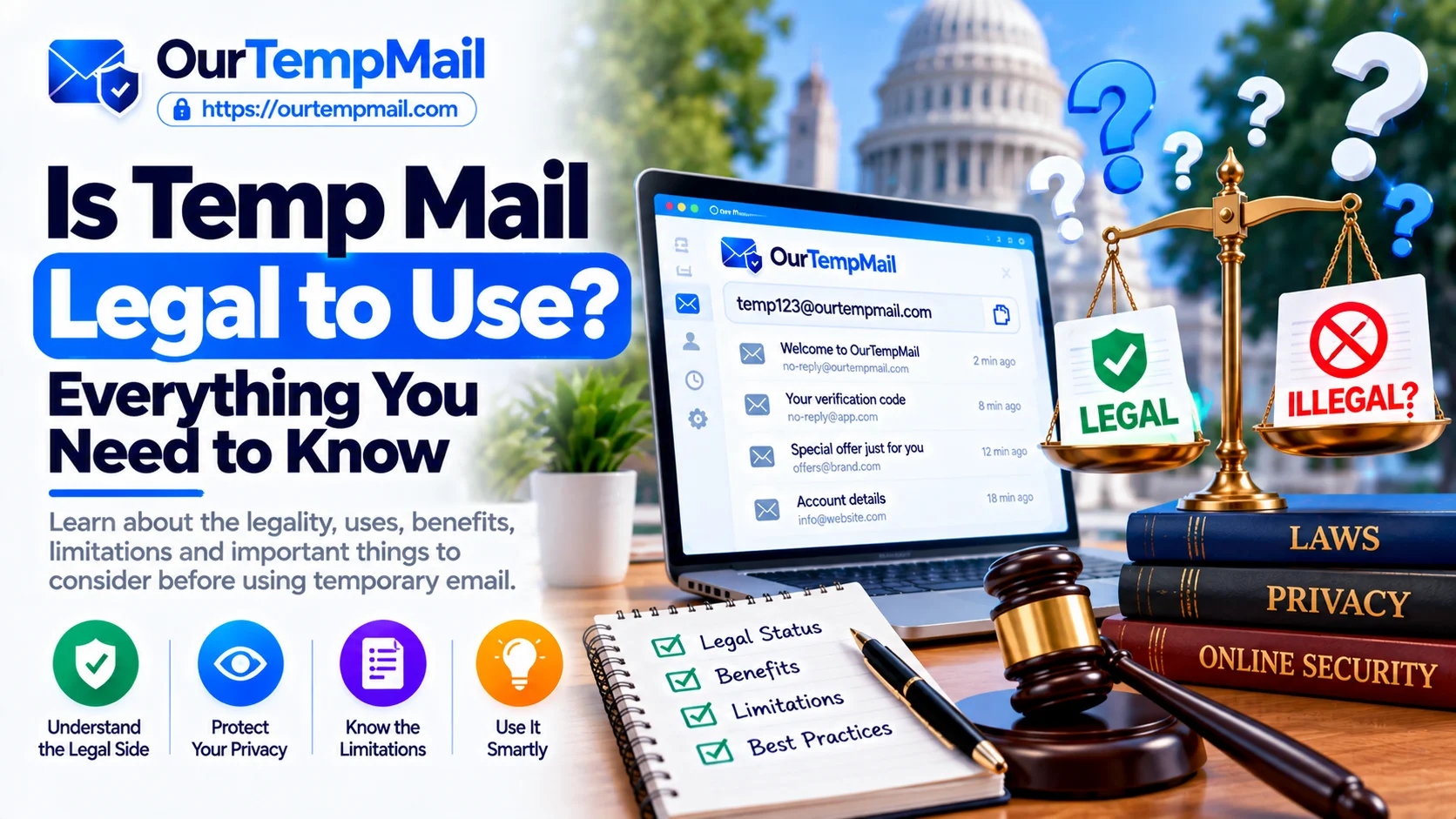
It is a fair question. You are using an email address that is not your real one, it disappears after use, and it lets you register on platforms without revealing your identity. That combination sounds like it could raise some legal flags, especially to someone who has never used a temp mail service before.
The direct answer is that using a temporary email address is completely legal. There is no law in any major jurisdiction that requires you to provide your permanent personal email address to every website, app, or service that asks for one. Privacy tools are widely used, broadly accepted, and using them is a recognized right in most parts of the world.
But there is more to this question than a single yes or no. Understanding why temp mail is legal, where the actual legal lines are, and how to use it responsibly helps you make better decisions about when to reach for a disposable email and when to use your real address. This guide covers all of it.
Generate a Free Temporary Email Instantly on ourtempmail.com
What Is Temp Mail and Why Do People Think It Might Not Be Legal?
Before getting into the legality, it helps to understand why the question comes up in the first place. A temp mail service generates a working email address that you can use for sign-ups and registrations. The address receives emails, delivers verification codes, and then disappears when your session ends. There is no account attached to it and no personal information connected to the address.
The reason some people wonder about legality is that this sounds like it involves deception. You are giving a website an email address that is not your real one and that you know will stop working. From one angle, that sounds like it might be considered misleading or fraudulent.
From a legal perspective, however, it is neither. You provided a real, working email address that fulfilled the technical requirement at the point of sign-up. The address received the verification email. The account was created through the platform's own sign-up process. You did not access any system without authorization and you did not misrepresent yourself in any legally meaningful way. You simply chose not to share your permanent contact information. If you want to understand more about how the service itself works, our guide on what is temp mail and how does it work covers the technical side in full.
Is Temp Mail Legal in the United States?
In the United States, using a temporary email address is entirely legal. There is no federal law that prohibits the use of disposable email services, and no state law requires individuals to provide permanent contact information when registering for online services.
The CAN-SPAM Act governs commercial email practices in the US, placing obligations on businesses that send marketing emails. It does not place any obligation on individuals to receive those emails or to provide a permanent address to do so. The law is about how businesses behave, not about what email address you choose to use when signing up for their services.
The Computer Fraud and Abuse Act (CFAA) is often mentioned in discussions about online behavior. This law prohibits unauthorized access to computer systems. Using a temp mail address to register for a service that offers free sign-up does not constitute unauthorized access. You are using the platform's own registration system in the way it was designed to be used. The fact that you used a temporary address rather than a permanent one does not change this.
California's CCPA and similar state privacy laws actually support the idea of limiting your data exposure online. These laws give users rights around how their personal information is collected and used. Choosing to provide a disposable email rather than your permanent address is entirely consistent with the spirit and intent of these privacy protections.
Is Temp Mail Legal in the United Kingdom and Europe?
In the United Kingdom and across the European Union, using a temporary email address is legal. The GDPR, which governs data protection across the EU and continues to influence UK law after Brexit, gives individuals strong rights around how their personal data is collected and used. Choosing to provide a temporary rather than permanent email address when signing up for an online service is a straightforward exercise of personal data control that is entirely consistent with GDPR principles.
The right to data minimization under GDPR, which holds that individuals should share only the data necessary for a given purpose, actually supports the use of temp mail for short-term registrations. If a website needs your email only to verify account creation, a temporary address fulfills that purpose without sharing more personal information than the situation requires.
There is no law in any EU or UK jurisdiction that requires private individuals to provide permanent contact information to commercial websites. The legal obligations around email address collection are on the businesses collecting the data, not on the users providing it.
Is Temp Mail Legal Elsewhere in the World?
In the vast majority of countries, using a disposable email address is legal. Privacy tools of all kinds are in widespread use globally and there is no broad international legal framework that prohibits individuals from protecting their personal contact information during online sign-ups.
Countries with strong data protection frameworks including Canada, Australia, Japan, Brazil, India, and most of Southeast Asia have privacy laws that focus on the obligations of businesses handling personal data, not on the individuals sharing it. Using a temp mail address is consistent with the personal privacy protections these frameworks provide.
There are a small number of countries with heavily regulated internet environments where the use of anonymizing tools may be restricted in various ways. In those contexts, the legal situation depends on the specific local regulations and is worth checking independently. For the overwhelming majority of internet users in the world, however, the answer is the same as everywhere else. Temp mail is legal.
Generate a Free Temporary Email Instantly on ourtempmail.com
When Does Using Temp Mail Cross a Legal Line?
Temp mail itself is legal. How you use it in specific situations can matter, however. There are circumstances where using a temporary email address as part of a broader pattern of behavior could contribute to legal issues, even though the temp mail service itself is not the problem.
Circumventing Paid Access
If a website offers a free trial that is intended to be a one-time offer per user, and you use multiple disposable email addresses to access that trial repeatedly, this could be considered a violation of the platform's terms of service. Depending on the jurisdiction and the specifics of the situation, repeated exploitation of systems in this way could potentially expose you to civil liability from the platform, though this is relatively rare in practice.
The key distinction is between using a temp mail address to access something that is genuinely free and open to anyone, versus using multiple temporary addresses to repeatedly access something that was intended to be a limited offer. The first is entirely fine. The second moves into territory that platforms can legitimately take action against, even if the legal exposure for the user is typically limited.
Violating Platform Terms of Service
Most platforms have terms of service that include language about the accuracy of information provided during registration. Using a temporary email address does not necessarily violate these terms because you provided a real, functioning email at the time of sign-up. The address worked. The verification went through. The account was created properly.
Where it might come into tension with terms of service is if a platform explicitly prohibits disposable email addresses in its registration rules. Some platforms do include this restriction, and using a temp mail address in that context could result in account suspension or termination. This is a terms of service issue rather than a legal one, but it is worth being aware of.
Using Temp Mail for Clearly Harmful Purposes
If temp mail is used as part of an activity that is itself illegal, the email tool being used does not provide any legal protection. Harassment campaigns, fraud, creating fake accounts for deceptive purposes, or any other activity that is illegal on its own terms remains illegal regardless of what email tool was involved. Temp mail is a privacy tool. It is not a shield for illegal behavior.
This is worth stating clearly because it is sometimes used to imply that temp mail is inherently associated with bad behavior. It is not. The vast majority of people who use disposable email addresses do so for entirely ordinary reasons like avoiding spam, protecting their inbox, and trying services without long-term commitment. Using any tool for illegal purposes makes the activity illegal. The tool itself is not the problem.
Is Temp Mail Safe as Well as Legal?
Legality and safety are related but separate questions. Temp mail being legal does not automatically mean every use of it is safe, and understanding the safety side is just as important as understanding the legal side.
Safe Uses of Temp Mail
Using a free temp mail address for sign-ups on websites you are not fully committed to, for free trial registrations, for online shopping, for accessing gated content, and for platform registrations where you want to protect your inbox from marketing emails are all entirely safe uses. The risk to you in these situations is essentially zero.
Situations Where Caution Makes Sense
A temporary email address should not be used for accounts where you need reliable long-term access. If you create an account on a platform using a temp mail address and later need to recover that account through email verification, the address will be gone and account recovery will fail. Banking, healthcare, legal services, and any account where you need ongoing access should always use a real, permanent email address.
The session-based nature of temp mail inboxes also means that any important information received during a session needs to be saved before the tab is closed. Verification codes, download links, and confirmation details that you might need later should be copied and stored elsewhere before the session ends.
What About Privacy When Using Temp Mail?
Privacy is one of the main reasons people use temp mail and it is worth being specific about what kind of privacy it provides.
A disposable email address protects the privacy of your real email address. When you use one for a sign-up, the platform never receives your actual contact information. It cannot use your real email for advertising targeting, cannot share it with data brokers, and does not have it to expose in a data breach. The protection is specific and meaningful for the way most people think about online privacy.
What temp mail does not do is protect your IP address, your browser fingerprint, or any personal information you choose to enter into a registration form beyond the email field. If a platform is seriously trying to identify you, an email address alone was never enough information to do that comprehensively. Temp mail removes one data point from the picture. For most everyday privacy needs, this is the data point that matters most because it is the one that enables ongoing contact and data accumulation.
For users who want to understand the full picture of why protecting your email address online matters, our guide on top reasons to use a fake email generator before signing up online goes into detail on each specific protection that a disposable address provides.
Responsible Use: How to Use Temp Mail the Right Way
Understanding that temp mail is legal does not mean every possible use of it is equally appropriate. Using it responsibly means understanding what it is for and applying it in the situations where it genuinely fits.
Use a temporary email address for short-term, low-stakes registrations where you do not plan to maintain ongoing access. Free trials you are genuinely evaluating. Online shopping at stores you are trying for the first time. Platform sign-ups you are not sure about. Downloads that require registration but nothing more. Forum access where your participation is casual rather than invested.
Use your real email address for anything important. Accounts that hold financial information. Healthcare platforms and medical records. Government services. Professional accounts tied to your identity. Any platform where reliable long-term access matters and where account recovery through email might one day be necessary.
The responsible approach is not to use temp mail for everything or nothing, but to apply it deliberately in the situations where it provides genuine benefit without creating practical problems. Most people find that once they understand this distinction, the habit of reaching for a disposable email in the right situations becomes second nature.
Final Thoughts
Is temp mail legal to use? Yes, clearly and completely. It is a privacy tool used by millions of people every day across every major country in the world. There is no law that requires you to hand your permanent email address to every website that asks for one. Using a temporary email address is a reasonable, responsible way to protect your privacy and your inbox without doing anything that crosses any legal or ethical line.
The questions worth asking are not about legality but about whether you are using it in the right situations. For short-term, low-stakes registrations, it is exactly the right tool. For important accounts with long-term access requirements, your real email is the appropriate choice.
Our Temp Mail is free, instant, and requires nothing from you. No account, no personal information, and no cost. The next time a website asks for your email and you are not sure you want to give your real one, the legal, practical, and privacy-conscious answer is already waiting at ourtempmail.com.
Generate a Free Temporary Email Instantly on ourtempmail.com